How to use powdered activated carbon for water treatment?
How to use powdered activated carbon for water treatment?
Struggling with stubborn water contaminants? Traditional methods can be slow and costly, letting impurities affect your quality. Powdered activated carbon offers a fast, effective solution for pure water.
Powdered activated carbon (PAC) is added directly to water, usually as a slurry, to quickly adsorb contaminants1 like organic compounds, tastes, and odors. [1] After sufficient contact time, the carbon particles are removed from the water through sedimentation and filtration processes, leaving purified water behind. [5]
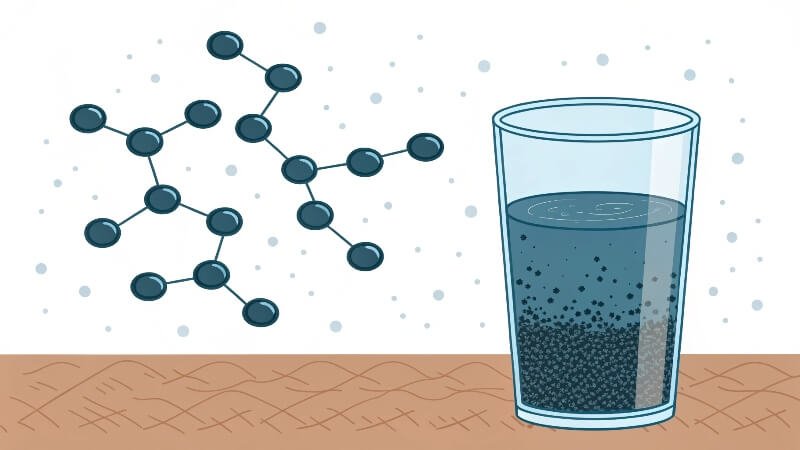
So, you can see the basic idea is simple: mix it in, let it work, and take it out. But the real success comes from getting the details right. As someone who has spent over 20 years in carbon technology, I've seen how a little knowledge can make a huge difference in performance. Let's dive deeper into how to use PAC correctly. This will help you make the best choice for your specific water treatment challenges and ensure you get the results you need every time.
How is powdered activated carbon used in water treatment?
Are you unsure about the exact steps for applying PAC? Applying it the wrong way can waste material and give you poor results. Understanding the process guarantees you get the best purification performance.
PAC is typically added to water as a slurry at a specific point in the treatment system. [1] It mixes with the water, adsorbs pollutants, and is then removed along with other solids during the clarification and filtration stages. [5] This method is highly effective for targeted contaminant removal. [1]
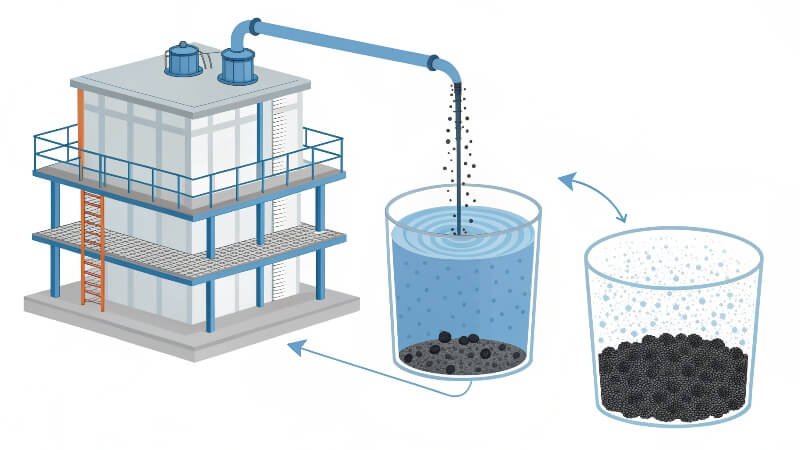
When I work with clients like David, a procurement manager who needs reliable solutions, the conversation always turns to the practical steps. The "how" is just as important as the "what." Using PAC isn't just about dumping powder into a tank; it's a controlled process. First, we decide whether to add it as a dry powder or a slurry. For higher or more frequent doses, a slurry made by mixing PAC with water is much better because it prevents dust problems and mixes more evenly. [17] The injection point is critical. We usually add the PAC slurry early in the process, like at the raw water intake, to give it enough time to work before other chemicals like chlorine are added. [1] This contact time is essential. For most taste and odor compounds, 15 to 30 minutes is enough, but for stubborn things like algal toxins, it might need longer. [1] After the PAC has done its job adsorbing impurities, it is removed. It clumps together with other particles during coagulation and settles out. [10] Any remaining fine particles are then caught by the filters, ensuring no carbon gets into the final water supply. [1]
What is the difference between powdered activated carbon and granular activated carbon?
Are you confused about whether to use powdered or granular carbon for your system? Choosing the wrong type can be an expensive mistake that impacts your efficiency. Knowing the key differences helps you select the most cost-effective and practical option.
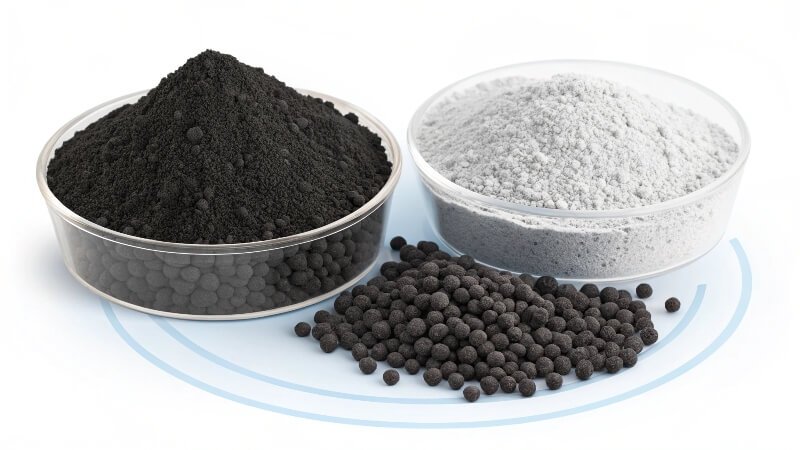
The main difference is particle size. [9] Powdered activated carbon (PAC) is a fine powder, while granular activated carbon2 (GAC) consists of larger particles. [2] This size difference dictates their application; PAC is used for short-term, batch dosing, while GAC is used in filter beds for continuous, long-term treatment. [12]
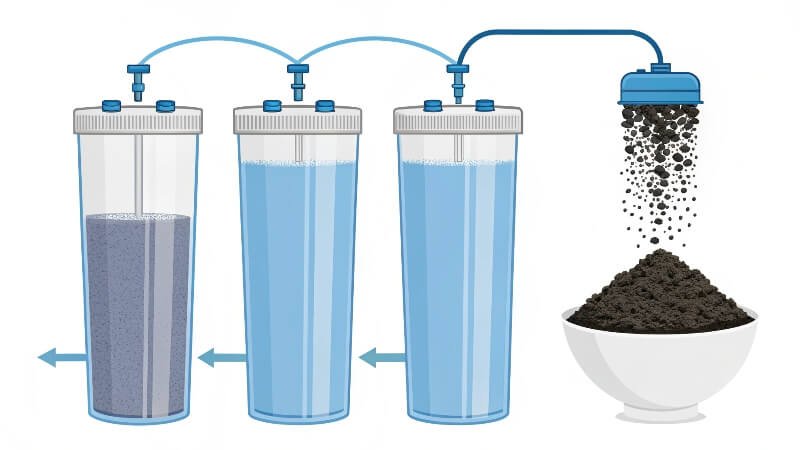
I often explain to procurement managers that the choice between PAC and GAC depends entirely on their operational needs. PAC is like a quick-acting medicine for acute problems, while GAC is more like a long-term preventive measure. Because PAC particles are so small, they have a huge surface area, which allows them to adsorb contaminants very quickly. [9] This makes PAC perfect for seasonal issues like algae blooms or for facilities that only need occasional treatment. [4] However, its biggest drawback is that it's a single-use product3. Once it's used, it's filtered out and becomes part of the sludge, which needs disposal. [2, 4]
GAC, on the other hand, is used in large filter beds where water passes through it continuously. [12] It works more slowly, but it's a durable, long-term solution. The key advantage of GAC is that it can be regenerated. After several months or even years of use, the saturated GAC can be removed and thermally reactivated to be used again, which can be more cost-effective for plants with constant contamination issues. [13]
Here is a simple table to break it down:
| Feature | Powdered Activated Carbon (PAC) | Granular Activated Carbon (GAC) |
|---|---|---|
| Particle Size | Very fine powder (<0.18 mm) [9] | Larger granules (0.2 - 5 mm) [9] |
| Application | Added as a slurry for batch or seasonal treatment [2, 5] | Used in filter beds for continuous treatment [12] |
| Adsorption Rate | Very fast due to high surface area [9] | Slower, depends on flow rate and contact time |
| Regeneration | Cannot be regenerated; single-use [4, 13] | Can be regenerated and reused multiple times [13] |
| Capital Cost | Lower initial cost for dosing equipment [4] | Higher initial cost for filter beds/contactors [2] |
| Use Case | Taste/odor issues, seasonal problems, spill response [1] | Continuous removal of organics, chlorine, and contaminants [17] |
Does powdered carbon dissolve in water?
Are you worried that powdered carbon might dissolve and remain in your water? This common misunderstanding can stop you from using a very powerful purification tool. Let's clear this up so you can use it with confidence.
No, powdered activated carbon does not dissolve in water. [15, 20] It is an insoluble solid. [1, 23] Instead of dissolving, it forms a suspension where the fine particles are dispersed throughout the water. These suspended particles are then physically removed through sedimentation and filtration4. [5]
This is a question I get a lot, and it's based on a simple mix-up between dissolving and suspending. When something like salt dissolves, its molecules break apart and mix completely with the water. Activated carbon doesn't do this. It's made to be a solid with a highly porous structure. [17] This structure is what gives it a massive surface area to adsorb contaminants1. [19] If it were to dissolve, it would lose this physical structure and its ability to purify water. The entire principle of its operation relies on it remaining a solid particle. [19]
Think of it like adding very fine sand to water. The sand swirls around and makes the water cloudy, but it never actually dissolves. The same is true for PAC. Because it remains a solid particle, we can use physical processes to remove it. In a treatment plant, we add chemicals called coagulants that make the tiny PAC particles stick together and form larger, heavier clumps called flocs. [10] These flocs, along with the contaminants they've adsorbed, become heavy enough to settle to the bottom of a tank. Any particles that are too small to settle are easily caught by downstream filters, ensuring the final water is clear and free of carbon. [1, 7]
What are the disadvantages of powdered activated carbon?
Are you thinking PAC is the perfect solution for every situation? Overlooking its downsides can lead to operational headaches and unexpected costs down the road. Knowing the disadvantages helps you plan better and use it more effectively.
The main disadvantages are that it cannot be regenerated, which leads to disposal issues5 and potentially higher long-term costs. [4] It can also create dust during handling, and its dosage requires careful control to avoid waste or impacting final water quality. [2, 8]
While I'm a huge advocate for activated carbon, I always tell my clients to look at the full picture. PAC is a fantastic tool, but it has limitations you need to plan for. The most significant disadvantage is that it's a single-use product. Unlike GAC, you can't realistically regenerate PAC on-site, so you have to keep buying new material. [4, 13] This also means the used carbon adds to the volume of sludge produced by the treatment plant. [22] This sludge must be properly handled and disposed of, which adds to the overall operational cost. [8, 25]
Another practical challenge is handling. PAC is a very fine powder that can easily become airborne, creating dust. [2] This is not only messy but also requires proper dust collection systems and personal protective equipment for operators to ensure safety. [8, 13] Finally, getting the dose right can be tricky. If you add too little, you won't remove all the contaminants. If you add too much, you are wasting money, and you risk some of the fine carbon particles passing through the filters, which can cause issues in the distribution system. [1] Careful monitoring and control systems are needed to manage this effectively. [5]
Conclusion
Powdered activated carbon is a fast, low-cost water treatment tool for specific problems. However, it cannot be recycled and has handling challenges6. You must choose between PAC and GAC based on your specific operational needs7 and long-term goals.
Learn about the adsorption process and how PAC effectively removes impurities from water. ↩
Understand the key differences between PAC and GAC to make informed choices for water treatment. ↩
Discover the implications of PAC being a single-use product and its impact on water treatment. ↩
Gain insights into these crucial processes that work alongside PAC for clean water. ↩
Explore the challenges of disposing of used PAC and how to manage them effectively. ↩
Understand the practical challenges of handling PAC and how to address them. ↩
Find out how to assess your operational needs to choose the right carbon type for water treatment. ↩